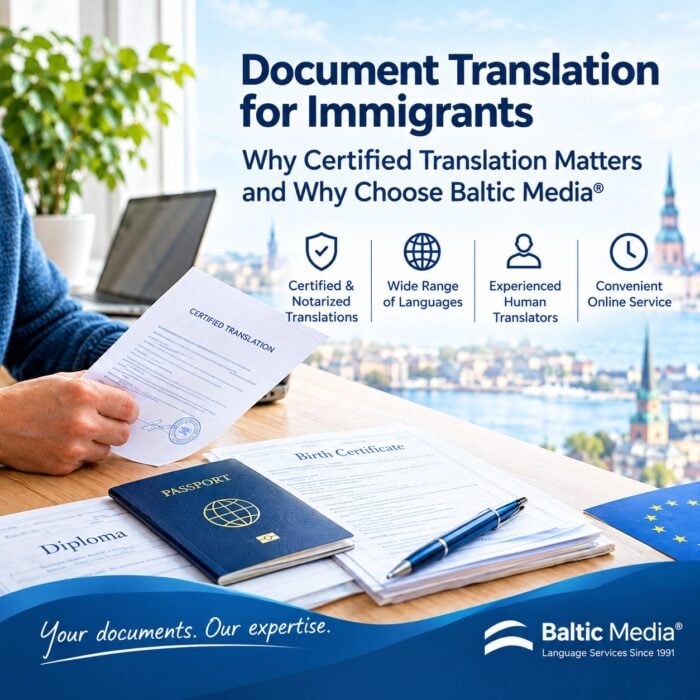
Document Translation for Immigrants: Why Certified Translation Matters
Moving to another country often means dealing with a long list of official documents. Birth certificates, marriage certificates, diplomas, passports, criminal-record certificates, employment documents, and other records may need to be translated before they can be submitted to immigration authorities, government institutions, universities, or employers.
For immigrants, document translation is not simply about translating words from one language into another. The translation may also need to meet specific certification, notarization, or formatting requirements established by the receiving authority.
What is certified document translation?
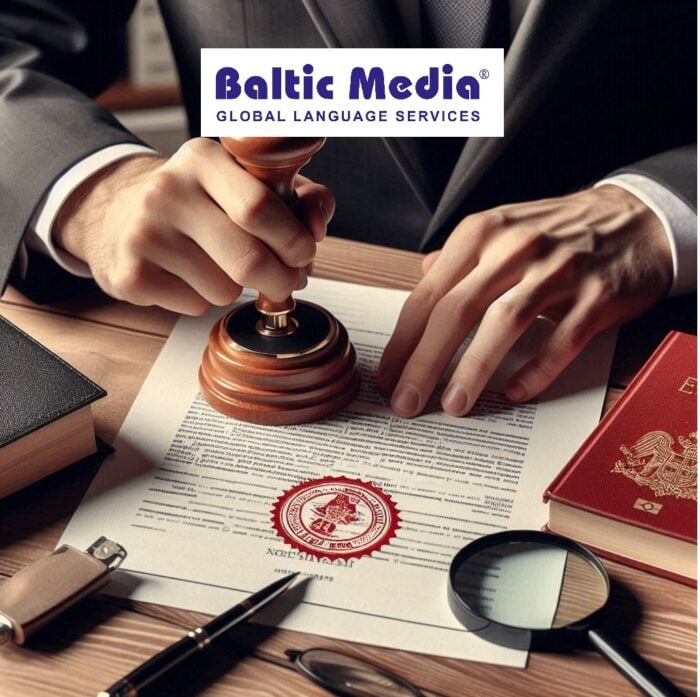
A certified translation is a translation accompanied by a formal certification confirming that the translation is accurate and complete. Depending on the country and institution, additional requirements may apply, such as notarization or certification by a specific type of translator.
The exact requirements vary. For example, EU guidance notes that an official translation may not always be required when a document is already in an accepted official language or when a multilingual standard form is available. In some circumstances, however, an authority can still request a certified translation.
Always check the requirements of the authority receiving your documents before ordering a certified translation.
Which documents do immigrants commonly need translated?
The documents required depend on the immigration procedure and destination country. Common examples include:
- Birth certificates
- Marriage and divorce certificates
- Passports and identity documents
- Diplomas and academic transcripts
- Criminal-record certificates
- Employment certificates and contracts
- Medical documents
- Bank and financial documents
- Powers of attorney
- Court documents
- Immigration and residency documents
- Certificates and official records
Baltic Media® provides professional document translation for legal, medical, academic, technical and business documents and offers certified and notarized translation services.
Why choose Baltic Media® for your certified translation?
1. More than 30 years of translation experience
Baltic Media® has provided professional language services since 1991 and works with private clients, companies, institutions and organizations internationally.
For immigration documents, experience matters because official documents require attention to terminology, names, dates, formatting and certification requirements.
2. Certified and notarized translations
Depending on the requirements of the receiving institution, Baltic Media® can provide certified and notarized document translations. The agency also explains different certification options so clients can determine which level of certification is required.
3. Online document translation
Immigrants do not necessarily need to visit a translation office in person. Baltic Media® accepts scanned documents digitally and can arrange delivery of certified translations by post.
This can be particularly convenient when you are already living abroad or preparing immigration documents from another country.
4. Nordic, Baltic, European and other languages
Baltic Media® specializes in Nordic, Baltic, Slavic and other European languages and provides document translation in a wide range of language combinations.
This makes the agency particularly relevant for people moving between countries in Northern Europe and the Baltic region.
5. Human professional translation
Official immigration documents require careful handling. Baltic Media® states that its professional translation services are performed by human translators, with quality-control processes applied to translation projects.
For documents containing legal names, personal data, official terminology and administrative information, human review is especially important.
Certified translation, notarized translation or sworn translation?
These terms are sometimes used interchangeably, but they can have different meanings depending on the country.
Certified translation generally includes a certification statement confirming the accuracy and completeness of the translation.
Notarized translation involves an additional notarial procedure. The precise legal effect depends on the jurisdiction.
Sworn translation refers to a translation produced or certified under a country’s specific sworn-translator system. Such systems are not identical across Europe.
Therefore, do not order a particular type of certification simply because it sounds more official. First ask the immigration authority, embassy, university or other receiving institution what it requires.
Do immigrants always need a certified translation?
No. The requirement depends on the destination country, the document, the language of the original document and the institution receiving it.
For certain public documents within the EU, multilingual standard forms can sometimes be used instead of translations. EU guidance also explains that authorities may exceptionally request a certified translation where necessary.
The safest approach is:
- Identify the authority receiving your document.
- Check its current translation requirements.
- Determine whether certification or notarization is required.
- Check whether an apostille or other legalization is necessary.
- Send the document to a professional translation agency.
- Request the appropriate certified translation.
- Check the completed translation before submitting it.
How to order a certified document translation from Baltic Media®
The process can be simple:
Step 1 – Send a scan or photo of your document.
A digital copy can be submitted online.
Step 2 – Tell us the source and target languages.
Step 3 – Tell us where the translation will be submitted.
Step 4 – Confirm whether certification, notarization or another form of authentication is required.
Step 5 – Receive a quotation and delivery time.
Baltic Media® provides document translation services online and can deliver certified documents to clients by post.
Why accuracy matters for immigration documents
A mistake in a birth date, personal name, place of birth, document number or legal term can create unnecessary questions or delays.
For this reason, immigration document translation should be treated as an official document process, not simply as a standard text translation.
The most important question is not only:
“Can you translate my document?”
but also:
“What type of translation will the authority receiving my document accept?”
Why Choose Nordic-Baltic Translation Agency Baltic Media®?
How to Reduce Translation Costs Without Sacrificing Quality
Why Human Translation Services is Your Best Choice?
Translate with Google, Bing, Microsoft, Tilde, Yandex and Order Editing from Us!
Price Quotations at No Cost
Request for Information
Conclusion
For immigrants, professional document translation can be an essential part of preparing applications for residence, citizenship, education, employment or other official procedures.
Baltic Media® combines professional human translation, certified and notarized document translation, online service and extensive experience with Nordic, Baltic, European and other languages.
Before ordering, however, always confirm the exact requirements of the authority receiving your documents. Certification requirements can differ significantly between countries and institutions.