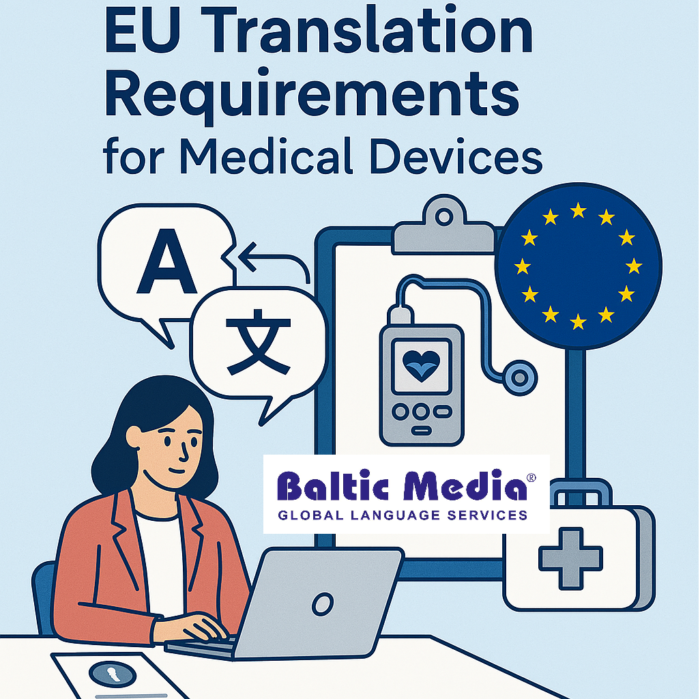
When medical device manufacturers target the European market, they naturally focus on the heavy hitters: rigorous clinical trials, exhaustive risk assessments, and the complex path to securing a CE mark under the EU Medical Device Regulation (MDR) 2017/745.
However, many brilliant products face unexpected, costly delays at the final hurdle for a reason unrelated to engineering: translation.
Under the EU MDR, translation is no longer a post-approval afterthought or a simple localization task. It is a core compliance requirement monitored heavily by Member State gatekeepers (importers, distributors, and Notified Bodies). If a user or regulator cannot understand your safety information, the device is legally considered unsafe.
Here is a breakdown of what the EU MDR requires, what needs to be translated, and how to build a compliant workflow.
1. The Core Rule: Clarity, Not Choice
The overarching mandate comes down to Article 10(11) of the MDR:
“Manufacturers shall ensure that the device is accompanied by the information set out in Section 23 of Annex I in an official Union language(s) determined by the Member State in which the device is made available to the user or patient.”
The subtle shift from the old Medical Device Directive (MDD) to the MDR is all about enforcement. The EU does not have a single, unified language policy. Instead, each individual Member State dictates its own requirements. Depending on where you sell, you may need to translate your content into any of the 24 official EU languages.
The Audience Split
National rules often depend heavily on who is using the device:
-
Patient/Layperson Facing: Almost every single Member State strictly requires translation into their official local language(s) for patient-facing materials. No exceptions.
-
Healthcare Professional (HCP) Facing: Some countries (like Portugal or Poland under specific conditions) may permit documentation strictly intended for professional use to remain in English. However, others (like France or Italy) mandate the local language regardless of the user’s medical credentials.
2. What Exactly Needs to Be Translated?
Compliance expands far beyond just the paper booklet in the box. The European Commission’s updated language guidance outlines a comprehensive list of required materials.
| Document Type | Translation Scope & Nuance |
| Instructions for Use (IFU) | Comprehensive local language translation; must balance highly technical precision with absolute readability for the end-user. |
| Device Labels & Packaging | Must include localized warnings, symbols, and descriptions on both primary and transport packaging. |
| EU Declaration of Conformity (DoC) | Legally required to be translated into the official languages mandated by the Member States where the device is sold. |
| Summary of Safety and Clinical Performance (SSCP) | Mandatory for Class III and implantable devices. Must be translated for public upload to the EUDAMED database, often requiring separate versions for professionals and patients. |
| Field Safety Notices (FSNs) | Urgent post-market safety communications must be distributed swiftly in the precise languages of all affected markets. |
The Graphical User Interface (GUI) Catch
While the MDR doesn’t explicitly single out software UI, the industry standard—backed by MedTech Europe—is clear: if your device’s screen displays safety-critical text, warnings, or vital operating parameters, that software GUI must be translated to match the language of the physical IFU.
3. How to Build a Compliant Translation Workflow
Because an error in a medical translation can lead to patient harm, product recalls, or immediate regulatory holds, relying on casual translation or unchecked AI is a major liability. A compliant process should look like a controlled loop integrated directly into your Quality Management System (QMS).
The Takeaway
MDR translation compliance is ultimately an investment in risk management. By partnering with translation teams certified in ISO 13485 (Medical Devices) and ISO 17100 (Translation Services), and utilizing Translation Memory (TM) tools to reuse approved terminology, you can safely scale your device distribution across Europe without risking costly regulatory bottlenecks.
Navigating the EU Medical Device Regulation (MDR) across the Nordic and Baltic regions reveals a striking reality: there is no unified regional policy. While these eight nations (the NB8 bloc) share tight economic bonds, their National Competent Authorities enforce vastly different language rules.
If you are expanding into these territories, you cannot rely on a single “regional” packaging strategy. The language requirements for Instructions for Use (IFUs) and device labeling across the Nordic and Baltic markets split into distinct regulatory paths depending on who is using the device.
The Nordic Countries: Strict Sovereignty
Nordic regulators fiercely protect local language requirements, especially for software and patient-facing materials. However, some flexibility exists for specialized healthcare professional (HCP) tools.
Sweden
-
Layperson Use: Swedish strictly required for labels, packaging, and IFUs.
-
Professional Use: Swedish is mandated for labeling and IFUs.
-
The Catch: The Swedish Medical Products Agency (MPA) explicitly includes Graphical User Interfaces (GUIs), control panels, display text, and standalone software under this Swedish language rule. The EU Declaration of Conformity (DoC), however, is accepted in English.
Denmark
-
Layperson Use: Danish strictly required.
-
Professional Use: Danish is required for both labels and IFUs.
-
The Nuance: The Danish Medicines Agency strictly interprets the mandate: all information necessary for safe and correct identification and operation must be in Danish, regardless of user credentials. True exemptions are rarely granted and require rigorous, individual justification.
Norway (EEA Member)
-
Layperson Use: Norwegian strictly required.
-
Professional Use: Norwegian is the default rule.
-
The Exception: You can apply to the Norwegian Medical Products Agency for an exemption to provide professional documentation in English, but it is evaluated case-by-case based on risk profile and intended user group. Implant cards must always be in Norwegian.
Finland
-
Layperson Use: Finnish AND Swedish (both are official national languages).
-
Professional Use: Dual language is the standard, but Finland utilizes a strict Risk Assessment Framework. Information necessary for “safe use” must remain in Finnish and Swedish. Other non-safety critical technical data may be provided in English if the manufacturer’s risk profile proves it safe for the specific HCP target.
Iceland (EEA Member)
-
Layperson Use: Icelandic. However, for lower-risk devices (Class I and IIa), Iceland uniquely permits IFUs to be in English or a Nordic language (other than Finnish).
-
Professional Use: English or another Nordic language (Danish, Swedish, Norwegian) is fully accepted.
The Baltic Countries: Pragmatic Adaptability
The Baltic nations lean more heavily on English accommodations for highly specialized clinical environments, though local languages remain uncompromised for retail or patient-use products.
Latvia
-
Layperson Use: Latvian strictly required for all consumer, patient, and retail medical devices.
-
Professional Use: Latvian or English is accepted, provided the device is intended strictly for use by professional healthcare specialists in clinical settings where English proficiency is guaranteed.
Estonia
-
Layperson Use: Estonian strictly required.
-
Professional Use: Estonian or English is permitted for professional-use equipment. However, the manufacturer must ensure that the specific institution receiving the device formally agrees that their staff possesses full English proficiency for safe operation.
Lithuania
-
Layperson Use: Lithuanian strictly required.
-
Professional Use: Lithuanian remains the mandatory baseline for both labels and IFUs. Unlike its Baltic neighbors, Lithuania does not maintain a broad, structural English exemption for professional-use medical devices; local translation is standard.
Summary Matrix for Quick Reference
| Country | Patient/Layperson Label & IFU | Professional Label & IFU | Key Local Twist |
| Sweden | Swedish | Swedish | Software GUI must be translated to Swedish. |
| Denmark | Danish | Danish | Strict enforcement; minimal exceptions for HCPs. |
| Norway | Norwegian | Norwegian (English via strict waiver) | Implant cards must always be localized. |
| Finland | Finnish & Swedish | Finnish & Swedish (English partial) | Requires a risk assessment for non-local text. |
| Iceland | Icelandic (English/Nordic for Class I/IIa) | English or Nordic | Most flexible region-wide language policy. |
| Latvia | Latvian | Latvian or English | Broad English acceptance for specialist clinical tools. |
| Estonia | Estonian | Estonian or English | Requires target user group capability verification. |
| Lithuania | Lithuanian | Lithuanian | Local language required across both sectors. |
Pro-Tip for Packaging Design: To avoid printing unique boxes for every single country, manufacturers targeting this region frequently create a “Nordic-Baltic Combo Label.” By utilizing international standard ISO 15223-1 symbols to eliminate text strings wherever possible, you can fit the remaining localized warnings into compact multilingual text blocks (e.g., SE/DK/NO/FI/LV/LT) on a single shared box or booklet.